How to Find Your Car's Paint Code and Order the Match
By the R&E Paint Supply team, 2026-10-06
A customer called one morning about a scraped bumper corner on his Silverado, reading us numbers off stickers by flashlight. The first string was a tire size. The next two were tire pressures. Then came a long code off the emissions label under the hood, and after that a block of short option codes from inside the glovebox. He had found four labels, and the number he needed was the shortest line on the last one he read.
After forty years of matching paint across this counter, we can tell you that is the most common way a color match goes wrong. Not the paint, not the gun: the code typed in at the start.
The short answer: open the driver's door and read the label on the jamb, where most cars print the paint code beside EXT PNT, C/TR, PAINT or COLOR. If it is not there, check the glovebox, the trunk and under the hood, or have a dealer pull it from your VIN. Then confirm it with a spray-out card.
The rest of this article walks the same path we walked him through on the phone, one sticker at a time.
Start with the paint code label on the driver's door
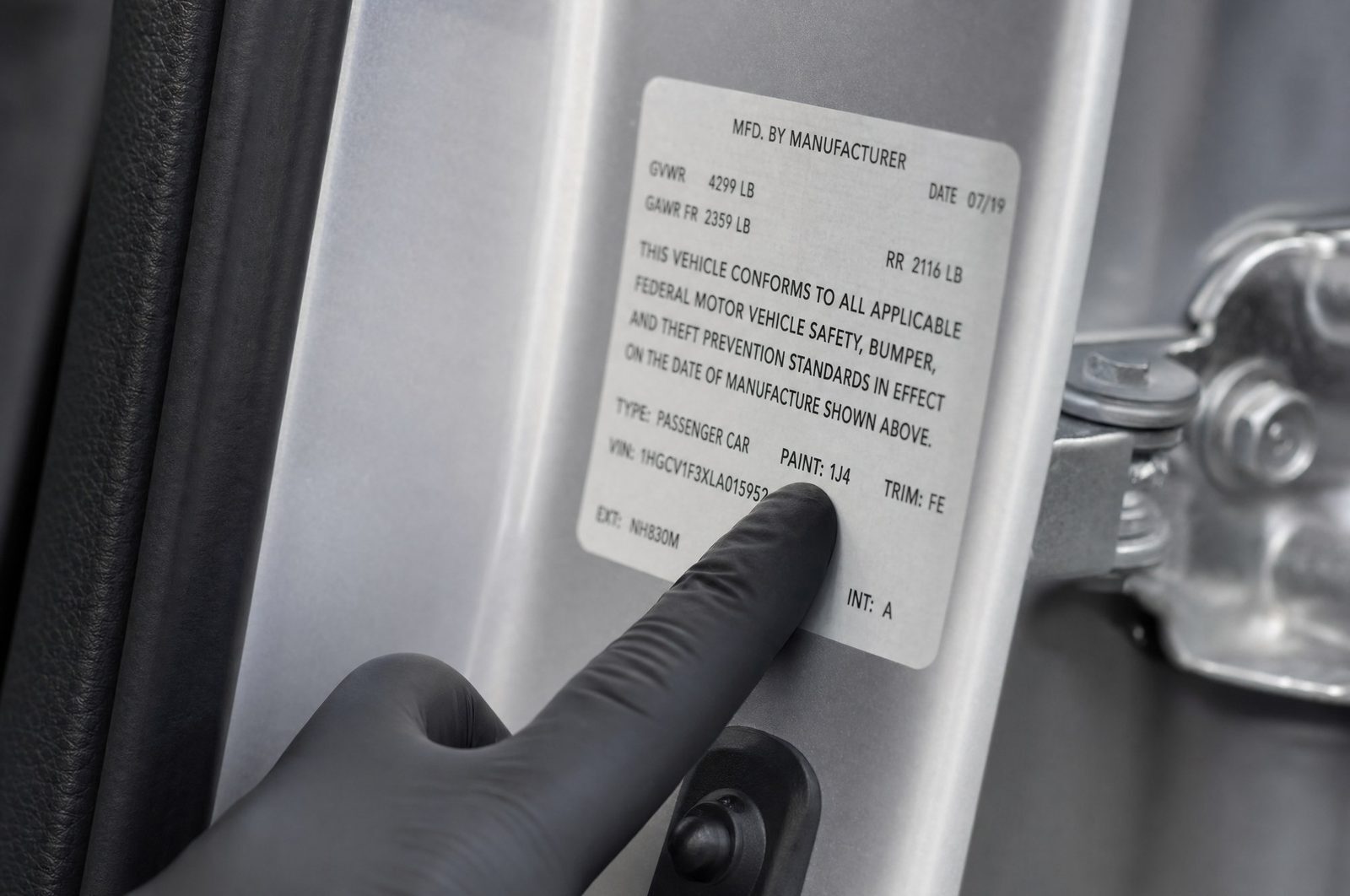
On most vehicles built since the mid 1990s, the answer is printed on the B-pillar. Swing the driver's door open and look for the certification sticker on the jamb or on the edge of the door itself; the paint code sits beside a heading such as EXT PNT, C/TR, PAINT or COLOR. Our Silverado caller started in the right place and still read the wrong sticker: the jamb also carries the tire and loading placard, and on his truck the paint line lives elsewhere.
The code is short, two to six letters and numbers, and it never spells out the color name. Bright White is a name; PW7 is a code. The name sold the car. The code pulls the formula, which is why we ask for the code and use the name only as a check.
Two habits save phone calls. Photograph the whole label rather than copying one line, so we can confirm you read the right field. And walk around the car before you trust the label: a repainted car, or one wearing a door from a different-color donor, will not match its own sticker. The tells are tape lines inside the jambs, overspray on the rubber seals and one panel with a different texture in raking light.
When the code is not on the door: where each make hides it
Every manufacturer has its habits, and once you know them the search takes a minute. Here is where to look by make, with the heading on the label and what a typical code looks like.
- Ford and Lincoln: the certification label on the driver's door jamb, field marked EXT PNT, two characters on newer vehicles (UG, YZ).
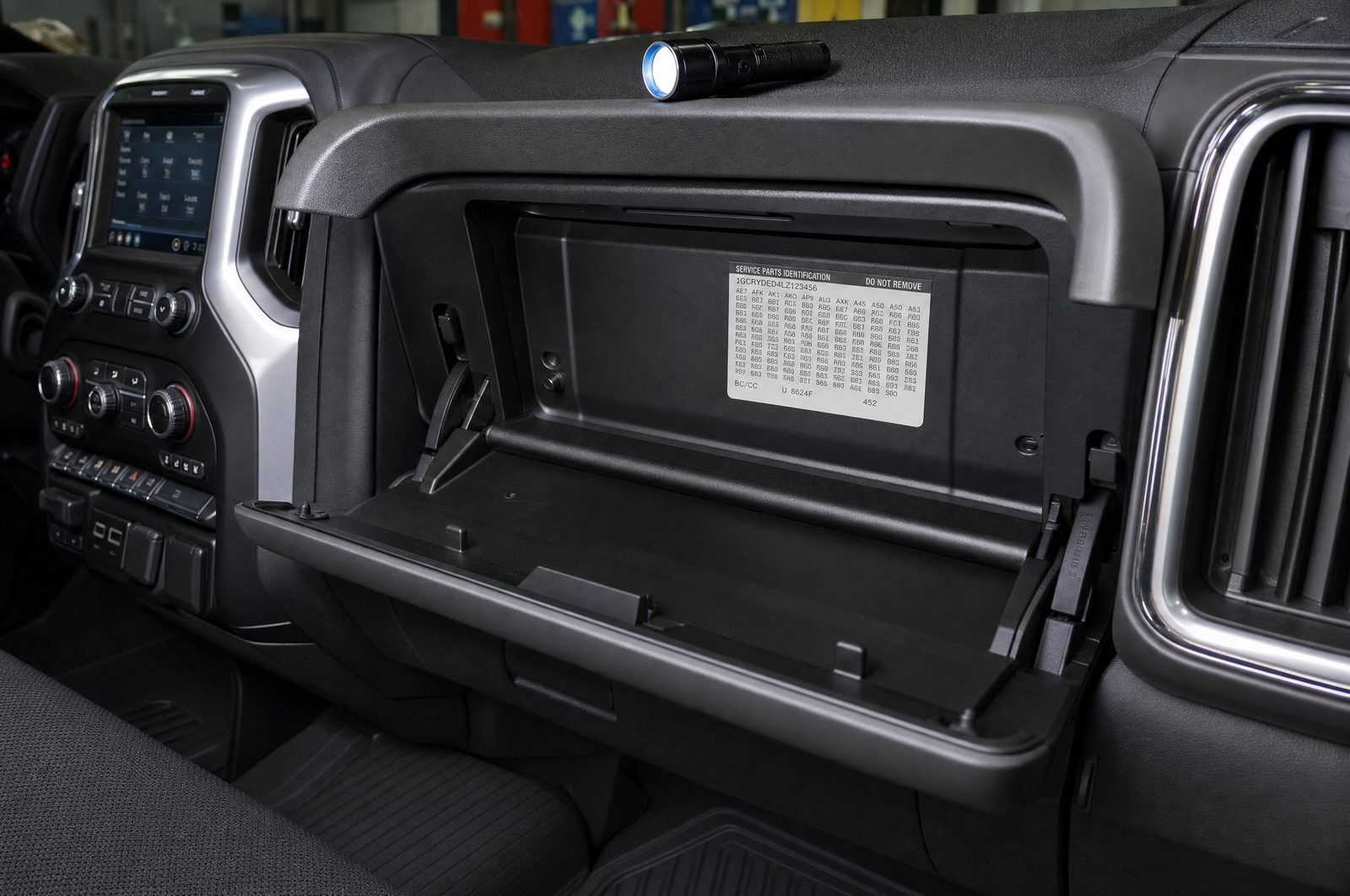
- Chevrolet, GMC, Buick and Cadillac: the Service Parts Identification label, usually inside the glovebox, sometimes in the trunk or console lid; the BC/CC line shows U and four digits, and the code is WA plus those digits (U 8624 is WA8624); on a two-tone, U is upper and L lower.
- Toyota and Lexus: the driver's door jamb label, line C/TR; paint code before the slash (202), interior trim after.
- Honda and Acura: the driver's door jamb; codes like NH-731P, where the last letter is the finish (P pearl, M metallic).
- Nissan and Infiniti: the driver's door jamb; three characters such as KH3 beside COLOR.
- Chrysler, Dodge, Jeep and Ram: the driver's door jamb; three characters beginning with P (PW7) beside PNT.
- Hyundai and Kia: the driver's door jamb, occasionally a plate on the firewall.
- Subaru: a label under the hood near the strut tower, or the passenger door jamb.
- Mazda: the driver's door jamb on most models, a firewall plate on older ones.
- Volkswagen and Audi: the data sticker in the trunk, under the floor cover or in the spare tire well (LC9X), duplicated in the front of the service booklet.
- BMW and Mini: under the hood on the strut tower or on the door jamb label, three digits (300).
- Mercedes-Benz: a black sticker on the driver's door jamb or a plate on the radiator support, three digits (197).
That GM line is where our caller's code had been all along. The Service Parts Identification label in his glovebox opens with a dense block of three-character option codes, and the paint sits quietly at the bottom on the BC/CC line. Once he read us the U and the four digits after it, the rest of the call was easy.
Older American vehicles used stamped tags instead of stickers: a GM cowl tag on the firewall or just below the windshield, a Chrysler fender tag on the inner fender, a Ford data plate on the driver's door. Those codes are year-specific, so on a restoration send us a photo of the tag and the year. A fender tag marked 999 means a special-order color. A window sticker or a build sheet under the back seat can also list it.
Getting the code from the VIN when the label is gone
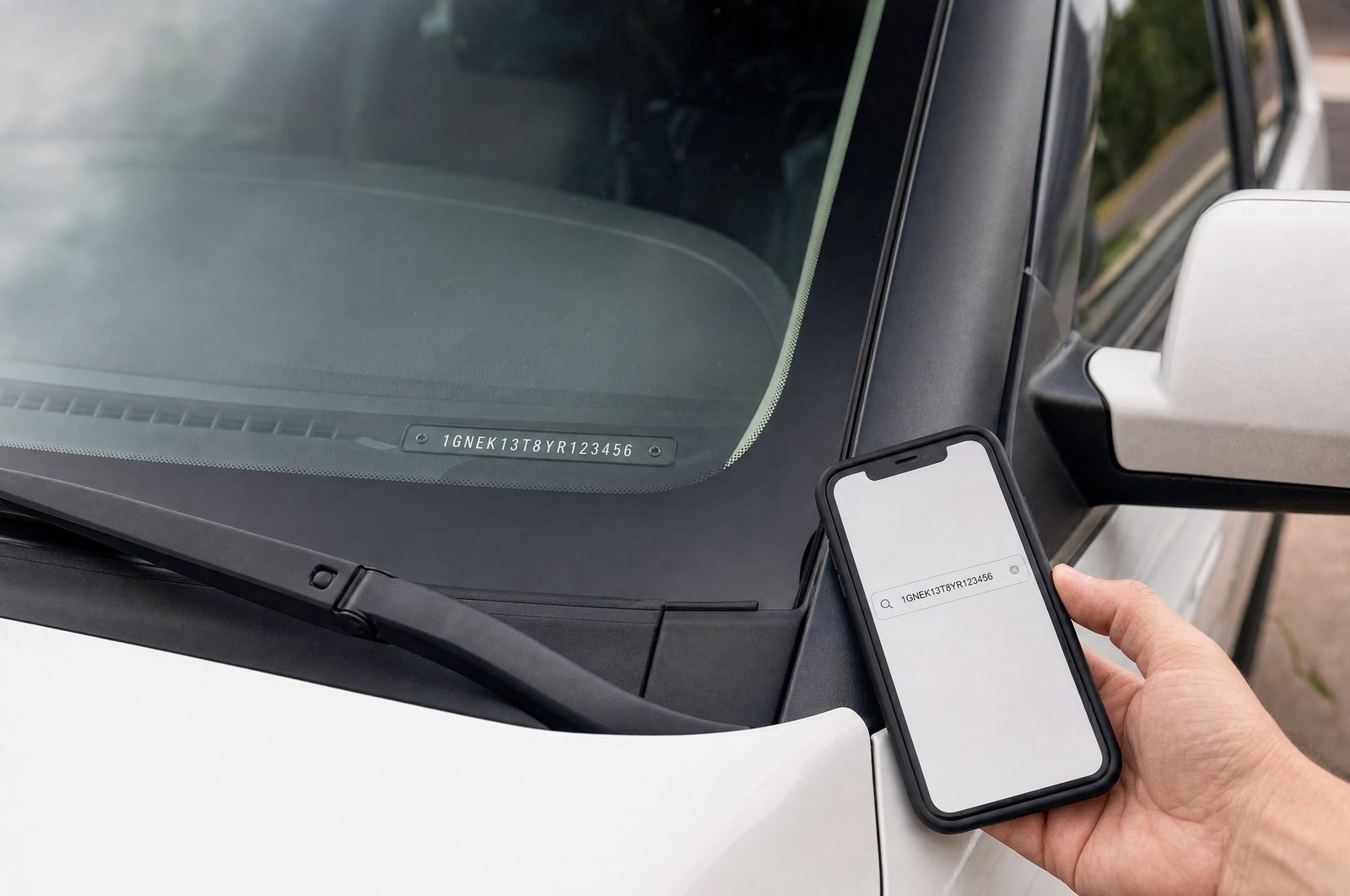
Labels do not always survive. A jamb that was sanded and repainted, a glovebox sticker that peeled off with an old registration, a trunk label faded to gray: when that happens, the VIN is the way back to the factory record.
The VIN does not contain the paint code, but it identifies the exact build, so a dealership parts department or the manufacturer's owner website can pull the color from it. Read the 17-character VIN off the plate at the base of the windshield or from the registration, and ask for the exterior paint code, not the color name.
Three cautions come with that route. The build record tells you what color the car left the plant in, not what color it is today, so a resprayed car or a swapped panel can carry a VIN color that no longer exists on it. Some manufacturer sites return only a color name, which is not enough on its own, because the same name can map to more than one code across model years. And on vehicles a few decades old the dealer database may not reach back, so the stamped tag matters.
Reading the right line: paint code, trim code and the stickers to ignore
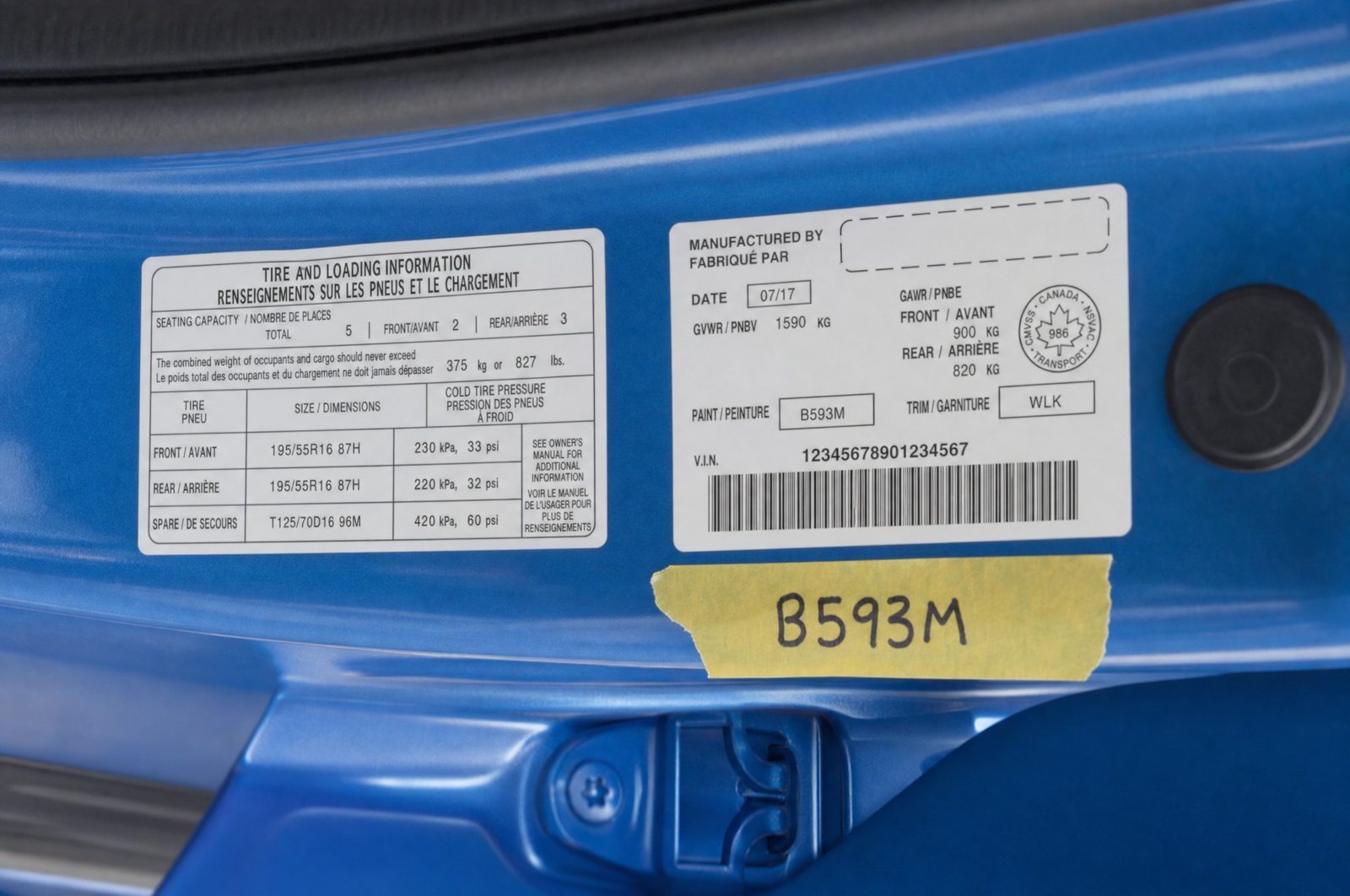
Finding a label is only half of it; our Silverado caller found four. The trouble starts on a crowded sticker, where the exterior color sits right beside the trim code, which is the interior color and material, in the same size characters and sometimes in the same box, separated only by a slash. It is the field most often read by mistake.
Toyota prints color and trim on one line as C/TR, color first. GM's BC/CC only means basecoat/clearcoat; the code is the U and four digits after it, filed under WA plus those digits. Ford marks the field EXT PNT so it cannot be confused with the trim, and Honda's suffix letter describes the finish, not a different color.
Then there are the stickers to ignore, and every one our caller read before the right one is on this list: the tire and loading placard on the door jamb, the emissions label under the hood, the VIN plate on the dash and any service stickers. On a GM glovebox label, the block of three-character codes is the option list; only the BC/CC line is paint.
Why one paint code can still mean more than one color
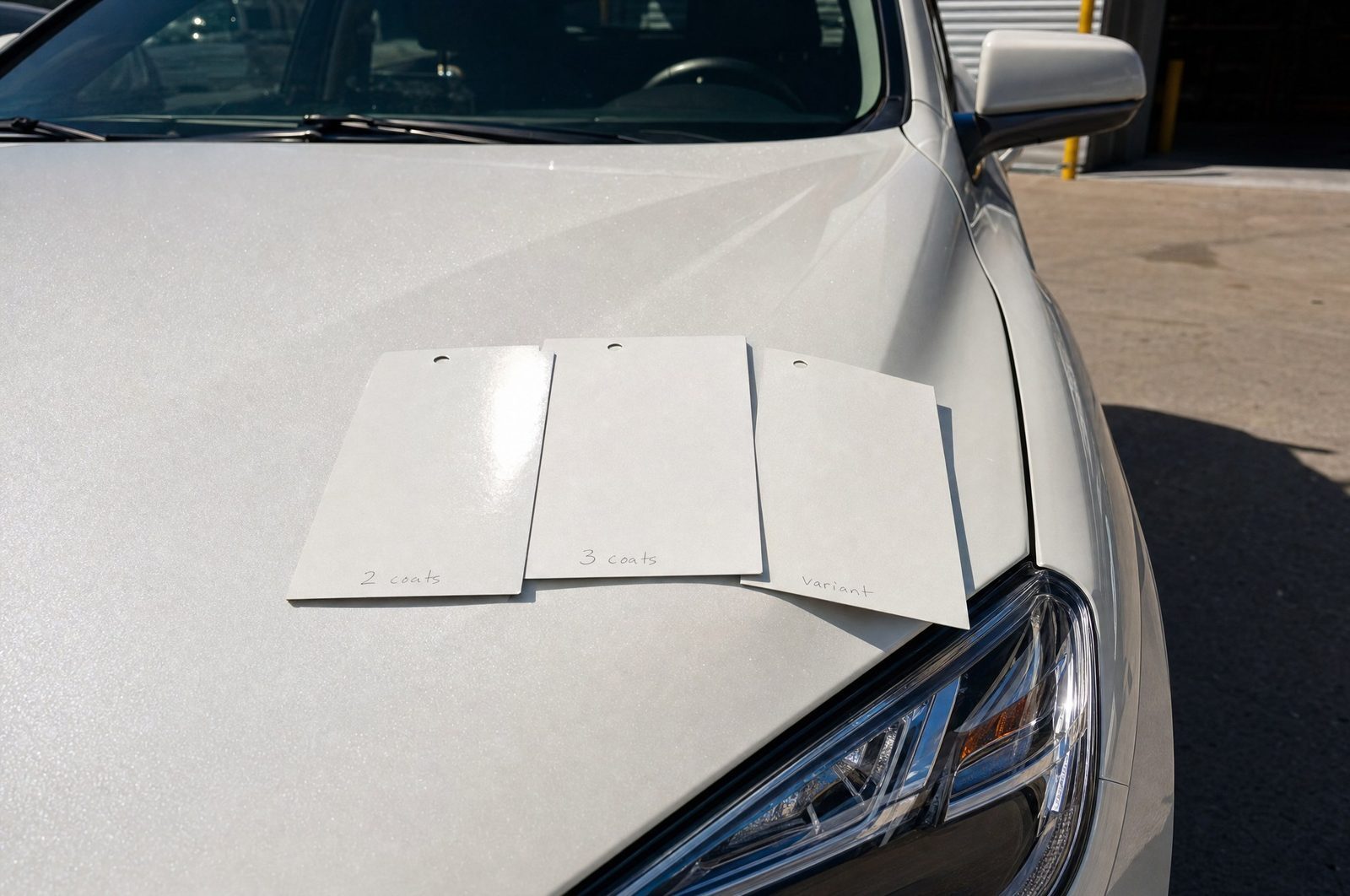
Getting the right code gets you the factory formula, and on a lot of cars that is not quite the same thing as the finish in your driveway. Many codes carry several approved variants, so two cars wearing the same code can sit side by side and look slightly different. That is normal, and it is why the refinish trade treats the code as the starting point rather than the answer.
Variants exist because the same color was sprayed at different plants, with paint from different suppliers and batches, across several model years. Paint companies record each one as an alternate under the same code; a popular code can have a handful and some have more than a dozen.
Tri-coats add a layer, literally. A pearl white or a deep pearl black is built in three stages: a ground coat that sets the base color, a translucent mid-coat carrying the pearl or mica, and the clear on top. The mid-coat changes the color as it builds, so two pearl coats and three pearl coats give two different whites. You can spot a tri-coat from the name on the color page, which says Tri-Coat beside the code, whether it is a Ford UG, a Toyota 070 or a GM WA815T, and the paint for it comes as two products, a base and a separate mid-coat, rather than one can.
Then there is age. Horizontal panels fade faster than vertical ones, so the roof and hood are lighter than the doors on the same car, and a fresh mix of the correct code is the color the car was, not the color it is. That is why a repair on an older car is nearly always blended into the next panel.
Ordering the color in the size the job needs
With the code in hand, the ordering is the easy part. Go to our R&E Automotive Paint year, make and model color match catalog, pick the year, make and model, choose the color, and the color page lets you pick the size. Match the size to the repair: a touch-up kit for a chip, an aerosol for a bumper corner or mirror cap, a quart for a panel, a gallon for the whole car.
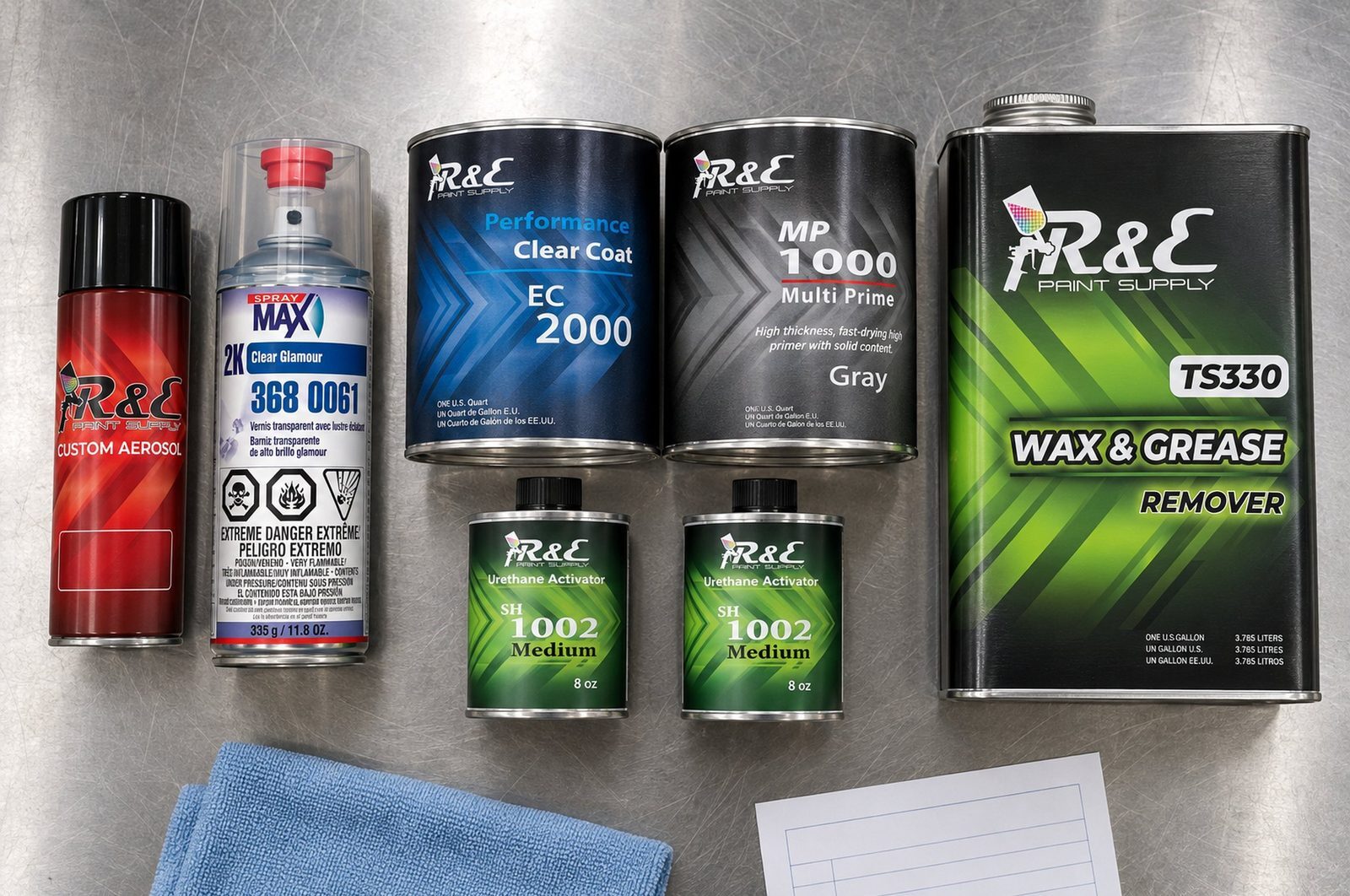
Every color page follows the same pattern, and Toyota 202 Black is a good example because it is one of the most common codes we mix: a low-VOC urethane basecoat mixed to the factory formula, with a Packing Size selector offering a Touch Up Kit, an 11 oz aerosol that is ready to spray, and 8 oz, pint, quart and gallon cans for a spray gun. The aerosol is what our Silverado caller needed for his bumper corner. It lays down basecoat only, which dries dull until clear goes over it, so we paired it with SprayMax 2K Urethane Glamour Clear Coat, a true two-component urethane in a can. You release the hardener from the bottom of the can, and from that moment it has a limited working life, so activate it when the basecoat has flashed and you are ready to clear, not the night before.
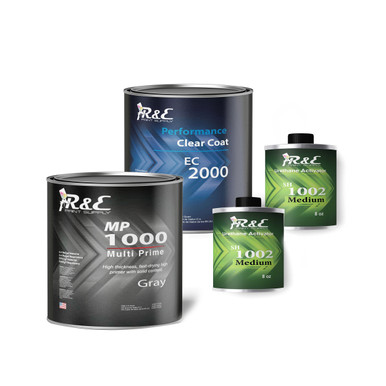
A door, a fender or a hood is a quart job with a spray gun: two to three coats with margin for a blend, a quart of 2K clear over it and, wherever the repair went to bare metal or filler, primer under it. The R&E Standard Paint Kit (Quart) is built for that pairing, a quart of EC2000 clear and a quart of MP1000 primer with their activators, sized to go with a color-matched quart. Three or more panels, or a full respray, move you into gallons, and at that scale it is worth calling us so primer, clear, activators and reducer are ordered with the color.
Before any paint touches the car, clean the repair and the panel around it with R&E TS330 Wax and Grease Remover: wet one clean towel, wipe, and dry with a second towel while the solvent is still wet. Silicone from tire shine, wax from the last detail and road film will make a perfect color match crater or peel. Color mixed to a code is made for you when you order it, so read the code twice before you type it. And the most common ordering mistake we see is an aerosol bought for a job that needed a quart.
Spray a card before you spray the car
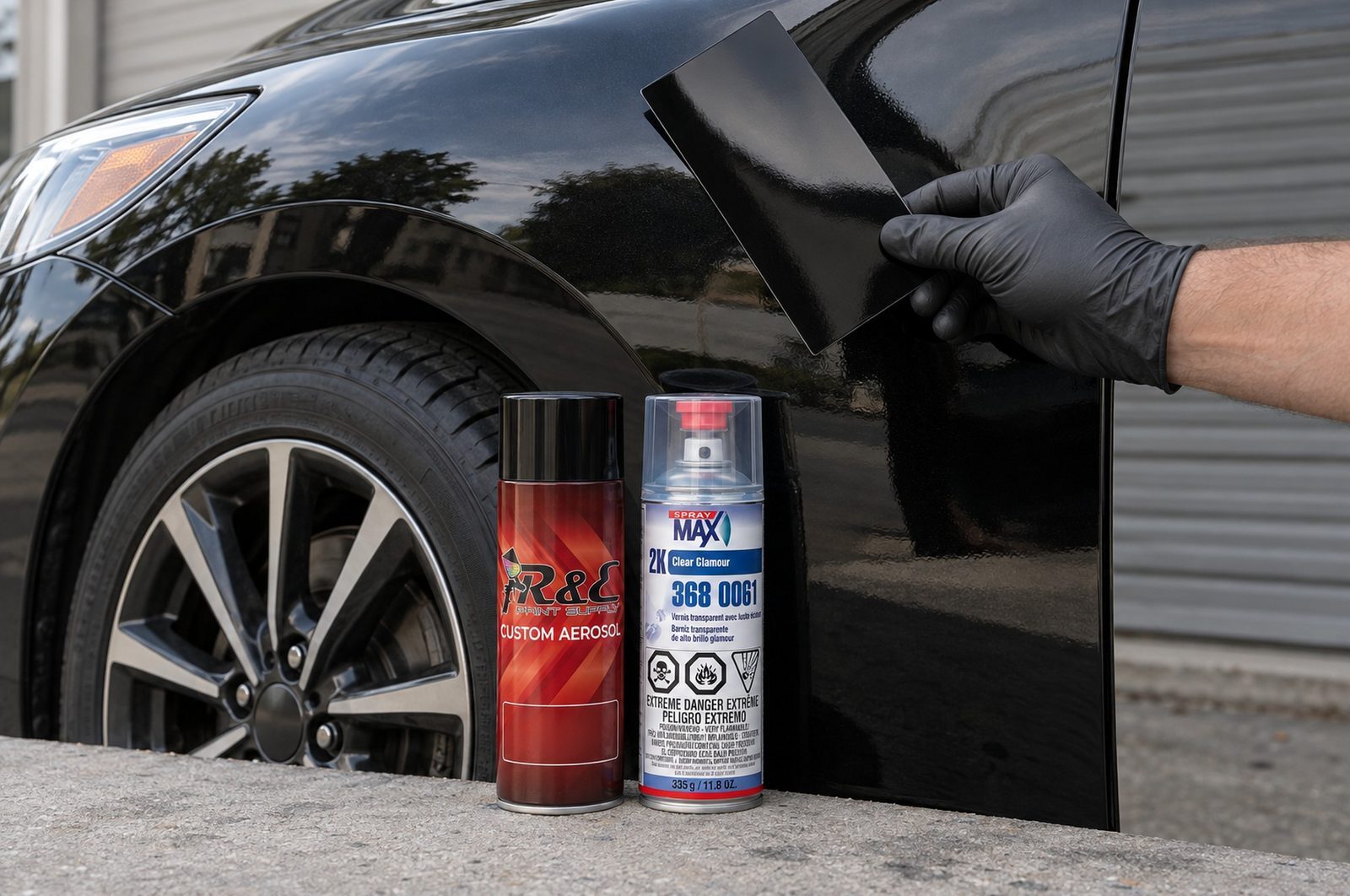
There is one more step between the right code and the right color, and most of it is patience. A spray-out card shows you how your paint, your gun and your technique actually land next to the car's aged finish, which the code alone cannot tell you.
Spray the card the way the panel will be sprayed: same gun or aerosol, same distance, same pressure, same number of coats, same flash time. Put clear on it, because clear deepens every color and you are matching a cleared finish. Let it dry before you judge it, a couple of hours for a solid and most of a day for a pearl. Then hold it against clean original paint beside the repair and look from three angles: straight on at the face, at about 45 degrees for the flash, and nearly edge-on for the flop. Metallics and pearls that match on the face and miss on the flop are the ones that show in the parking lot.
If the card is off, you have three honest options: try an alternate variant of the code, which is often the whole fix; adjust the application, since more or fewer coats of a metallic or a tri-coat mid-coat shifts the color noticeably; or plan a blend into the adjacent panel so the eye never sees a hard edge. Write the variant, the coats and the pressure on the back of the card and keep it.
That is where we sent our Silverado caller once he had read us the right line: one card, sprayed with the same aerosol and cleared, held against the bumper in daylight before a drop went on the truck. The code got him the formula. The card is what got him the truck.
A few more paint code questions from the counter
What if my car has two paint codes on the label?
A two-tone vehicle lists one code per color, and each is ordered as its own color; on GM labels the U line is the upper color and the L line the lower. If you are not sure which is which, send us a photo of the whole label.
Can I order paint by the color name if I cannot find the code?
Not with confidence. Manufacturers reuse color names across decades with different formulas, so a name is only a starting candidate; get the code from the VIN through a dealership parts department, or send us a photo of the label or tag, and confirm it with a spray-out card.
How long should a spray-out card dry before I compare it to the car?
Let it dry fully with clear on it: a couple of hours for a solid color and most of a day for a pearl. Wet paint and basecoat without clear both read a different shade than the finished repair will.
Shop the products in this article